.......... .. .. ........... "Once In A While You Get Shown The Light In The Strangest Of Places If You Look At It Right" :Robert Hunter

All of the music recordings on this site are recordings of independent origin (ROIOs) Music that has not been officially released. If you are an artist or a legal representative of an artist and you do not want your ROIO shared on my site for free among your fans (and creating new fans), just tell me in the comment area and I will remove them. By the way these recordings exist. They won't go away. All of them can be found at various places on line. Sharing just keeps the fans that support the artists from having to get ripped off by purchasing them on auction sites, and it also introduces music to people who would never have known the artist, creating a stronger fan base.

Showing posts with label Outdoors Subject Matter. Show all posts

Thursday, February 23, 2017

Willow Valley Loop hike, Arizona

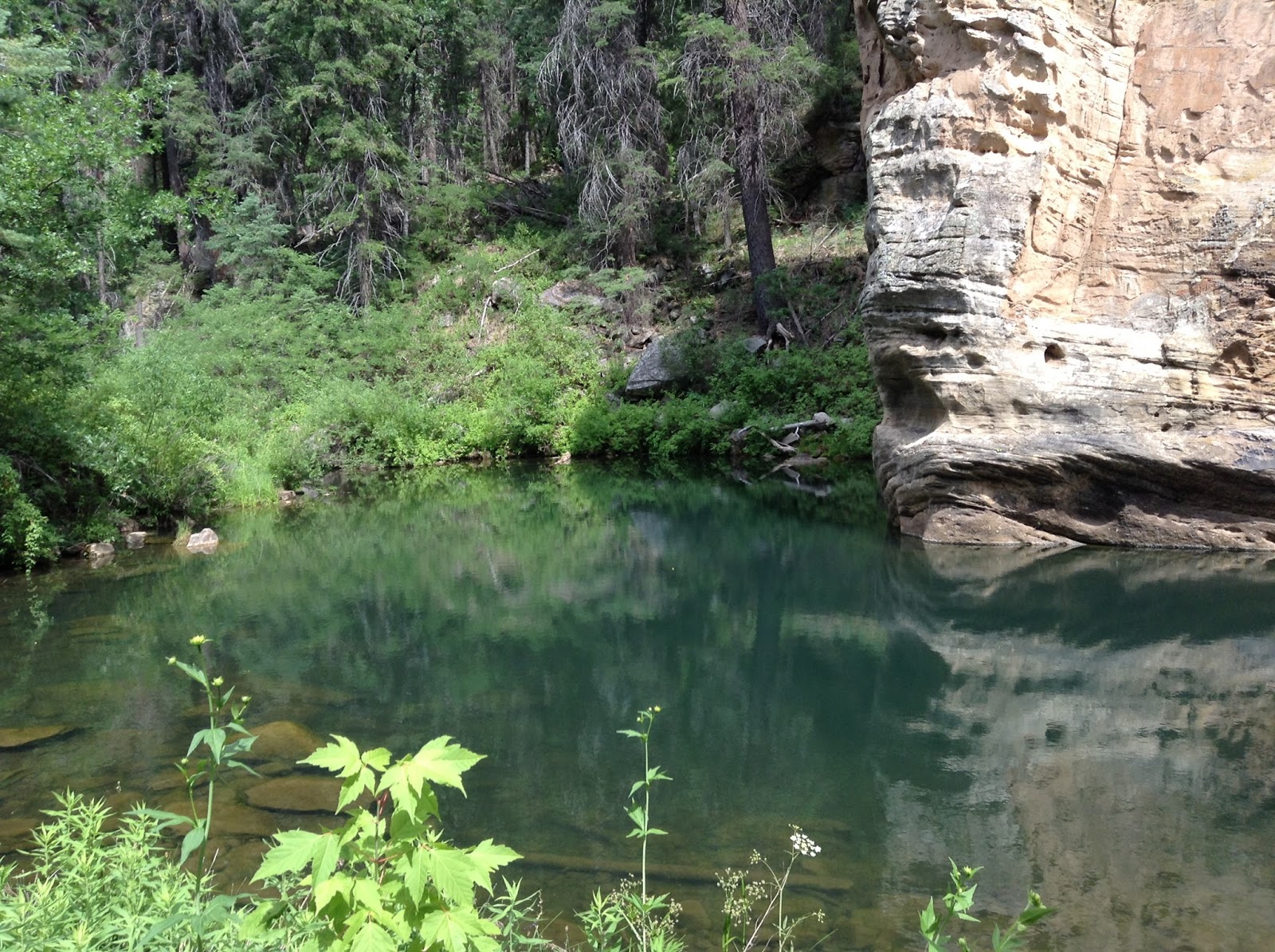
This hike is a rugged hike into a deep entrenched canyon with a stream and some deep pools you must swim. 
This hike is in a tributary and is at the headwaters of West Clear Creek.  Much of this is in a designated wilderness area.  The hike is mostly an off trail scramble and boulder hop down through the canyon bottom along a stream bed.  There is some fighting through brush and some thorn bushes involved that you should avoid if possible.  This is a long day and pretty rugged but the payoff of scenery is well worth it. 

This hike should only be done in warm weather since you will get wet and you should use dry bags to keep your stuff dry.  You should never enter this canyon if the weather forecast is for rain because flash floods could happen and be a great danger.  If you are not in decent shape don't try this because it is a long strenuous day and there is no way out but to do the whole loop once you pass the fist few swimming holes.  It is a one way loop hike that takes between 7 to 9 hours depending on how fast you can go.  There is a stretch of about 3 miles of dirt road that must be hiked or you can do a car shuttle or stash a mountain bike like I did at the Maxwell Trailhead.  I recommend you first do a day hike into Maxwell Trail to get an understanding of where the trail out is, because if you miss it at the end of your day you will be stuck in the canyon overnight and not know if the way out is upstream or down stream.  So for safety scout it out in advance to know the exit point of the canyon. 


Park you car at Maxwell Tank and walk east from the road past or around Maxwell Tank.  I went around the right side of the tank.

 You will have to get over a barbed wire fence and find your way down into the drainage or wash on the other side. Once in the bottom of the wash or drainage, turn right and head down the small canyon.  I found there to be lots of Locust plants with sharp thorns as well as some wild rose.  So this part scratched me up a little, but if you are careful you can probably get through without much damage.  Near the bottom of this side canyon you will encounter a series of dry falls or drops.  I was able to find ways to climb down or around each of them without too much difficulty.  After this you will reach the bottom of the main canyon of Willow Valley.  It takes around 45 minutes to get to this point.  I found the bottom of the canyon to be dry and boulder filled at this location.  You turn right or downstream and begin to boulder hop or climb what I thing was south.  After just a short distance you will come upon the first of a series of deep pools that you have to get through. 

 You might be able to find a way around some of them but the easiest way is just to swim through them (they are too deep to wade). 

  At least one of them there is no other way but to swim.  And on one of them I found no easy entrance other than to jump off a small drop into the water.  Once you do this there is no going back. 

 After this there are no more deep wades, so if you've used a flotation device to keep your pack dry, you can put it away.  I personally just used dry bags inside my pack.  I also bring a water filter so I don't have to carry a full days worth of heavy water.  Downstream from here there is a stretch where the canyon bottom is full of large boulders and rocks. 

 So you boulder hop and route find your way down the canyon.  After a while of this boulder hopping you will start to see pools of water again but nothing you have to swim.
  There are some sections where there are willow thickets you have to fight through.  The easiest way appears to be to stay in the water at these locations.  After a good distance of this the canyon begins to open up and you start to see running water.  

And soon the canyon bottom becomes more open and flat and filled with grass and brush.  You will find a few locations where you will have to wade across the stream and sometimes the grass makes seeing where your footing is supposed to go difficult.  After a while you will find there are some short sections with paths or trails up out of the drainage in some forested areas. 

 The farther you go you will find some actual sections of decent trail through the pines on benches along the canyons edge.  Finally you'll reach the confluence with Clover Creek, which comes in from the left.  This is a very important land mark because your exit point is around a half mile down stream from here.  From this junction down you are now in West Clear Creek and in this area you will find some nice large still pools and some places where people have camped.

  You could always just come down Maxwell Trail and just go a little ways up stream and camp.  And then return back up Maxwell Trail.  And just take it easy and enjoy this remote wilderness at your leisure.  If you stay overnight be reminded that there may be bears in this part of the canyon, but I have never seen any. 

From the Clover Creek confluence stay on the right side of the stream going downstream because you exit is on the right and you don't want to miss it.  There are more big still pools and great scenery as you go. 

After about a half a mile, just before a prominent side canyon enters from the right and the main canyon bends left, you should see some cairns and a well used trail which heads up the slope on the right (north). This is your way out, called Maxwell Trail #37.  From here you will start climbing and it becomes steep with some switchbacks in places.  It is a pretty good climb that takes you up to the rim of the canyon.  At the top you find a West Clear Creek Wilderness Boundary sign and a trail register and parking area. If you have spotted a car here or a mountain bike like I did, the hike part of the adventure is over.  If you did not do the car shuttle or stash a mountain bike you now start the walk along the forest service roads back to your car at Maxwell tank.  It is about 1.5 miles down the road to the junction where you turned of to go to Maxwell Tank.  Turn right at that junction and walk the remaining 1.4 miles back to Maxwell Tank and your car. 

 
To get to the trail head at Maxwell Tank  You turn west off Lake Mary Road between mile markers 297 & 298.  This is a few miles northwest of the Highway 87 intersection at Clint's Well or Happy Jack.  I believe there is a sign for West Clear Creek.  It is Forest Road (FR) #81. Follow FR #81 for 3.1 miles then turn left onto FR #81E. After driving 3.8 miles stay left (continuing on 81E) at the junction with FR #693. After another 0.5 miles you'll arrive at the junction with Maxwell Trail Road. To spot a car, stay right at this junction and follow it 1.5 miles (ignoring any faint side roads) to the signed trailhead. To reach the trailhead, turn left towards Maxwell Tank. After 0.9 miles a road will come in from the right (stay left), you will reach Maxwell Tank after another 0.4 miles.
Here are some links to information about the main canyon of West Clear Creek, that is down stream from this hike. 

Tuesday, October 27, 2015

Yellow Rock and Hackberry Canyon, Utah

In southern Utah there is a very large area that has been designated as the Grand Staircase-Escalante National Monument. This national monument spans nearly 1.9 million acres, and has very few roads. In the western part of the national monument is a dirt road that runs north to south called Cottonwood Wash Road. It is a rugged dirt road that is impassable in wet conditions and it sees light traffic. This road runs along the "Cockscomb" also known as the East Kaibab Monocline. This is a fold in the rock layers tilting them up at 45 degree angles in spots and forming a long ridge of strange rock formations due to the differential erosion of these layers of rock. West of this road is a large road less area that has few visitors that I like to visit. It has canyons with small streams, rock formations, slot canyons, and solitude that is hard to match. Along the East Kaibab Monocline is a large dome of sandstone called Yellow Rock. Yellow Rock sits on a ridge that divides Hackberry Canyon from the Paria River Canyon. Yellow Rock is a large bald dome of swirling colorful stone, and when I say large, I mean really large (like the size of a really large dome stadium). When I first came here this was my reason and destination but I found I loved the area because of the solitude and the many other attractions including slot canyons and rock formations. My favorite trip I have taken started where Hackberry Canyon cuts through the Monocline and meets Cottonwood Wash. I then traveled south down Cottonwood Wash for about 0.2 miles to the next small drainage coming down from the west. I walked up this drainage and took a trail which heads up to the right or north side of this small canyon. This trail climbs very steeply to a ridge then bends left or west, and once on the top it takes you to the massive form of Yellow Rock. Once at Yellow Rock I explored and climbed all over this crazy example of colored, patterned, and textured stone. There is no trail but you can't really get lost and it is pretty easy to walk around on. I have done this several times and it never gets old because you see something different each time. So this time I walked up to the top to see the great unblocked views in all directions of the surrounding areas. When at the top you will find that the northeast side of Yellow Rock drops off sharply into a deep narrow slot cut through the uplifted Navajo Sandstone. Looking northeast past the slot is a wonderland of slickrock domes including the prominent landmark of Castle Rock. Then after I got my fill I descended down off the large rock to the south where there is a sandy trail that I took that leads west into and area I call the rock garden, that has some free standing rocks of different shapes and sizes.
After about a mile or more I came to a trail junction where the Paria Box trail intersects the Yellow Rock trail. You can make a day hike loop of this if you take this left turn left here. It will take you to the Paria Box and back to Cottonwood Wash south of the Hackberry Canyon trailhead. Instead I stayed on the Yellow Rock trail that becomes just cow trails as you head north out of the rock garden area. After a little exploration of the Rock Garden I found a nice camp site among the rocks on the edge of Hackberry Canyon with fine views in several directions. I have camped here on a few occasions now, and I love the views, the solitude.
The next day I took the old cattle trail north for several miles along the ridge between Hackberry and The Paria. As I traveled north along this ridge top there were fine views to the northeast down into Hackberry Canyon.
And out to the west you can see wide areas including a prominent land mark mountain called Molly's Nipple, and the white cliffs of No Man's Mesa. To the north are the pink cliffs that make up Bryce Canyon National Park. Along the route there are many large areas of exposed rock with colors of white gray and even some more yellow areas. All with some strange shapes of spires, beehives and teepees, as well as flat textured areas. I camped the second night at one of these exposed rock areas at the top of Hogeye Canyon (a side canyon of the Upper Paria River Gorge). Out in this region there are no human footprints, no noise, just solitude. The next day I dropped into a side canyon of Hackberry Canyon called Sam Pollock Canyon where I passed some more interesting rock spires and shapes at the top of the canyon. I heard in this canyon there was a good sized arch called Sam Pollock Arch. It turned out to be a pretty nice arch carved out of the canyon wall that you can't miss as you travel down this canyon. I continued down Sam Pollock Canyon to where it meets Hackberry Canyon and turning south I splashed down the middle of the sandy stream bottom. In Hackberry Canyon there was a good amount of running water. I'm not sure if it runs all year or not. Lower Hackberry Canyon near Sam Pollock Canyon has red cliffs that are made up of the Kayenta and Moenave formations. As I approached Cottonwood Wash the cliff walls became much larger and closed in forming a narrow section as I passed through the East Kaibab Monocline that forms the Cockscomb. Here the walls of the canyon are towering Navajo Sandstone.
As you go through this narrow slot you are passing directly under Yellow Rock on the south side of the canyon. The walking is easy and just in a shallow sandy stream bed. I guess many people come just to day hike the Hackberry Canyon Narrows. The Narrows are short but impressive and I soon popped out at Cottonwood Wash where my car was parked. I have also hiked up to Yellow Rock from The Paria Box trail which takes you through some nice areas of the rock garden that are fun to explore. This route is alot longer to get to Yellow Rock but is not as steep and difficult. There is also a side trail from the Paria Box Trail to a rock formation called Red Top. It is a red colored rock formation that stands out among an area of mostly tan, white, or yellow rocks. This whole area is remote and good map skills and route finding ability are essential if you are going off trail at all. Up on the ridges there is no water so you have to pack it in, and any water in the canyons you must filter because of cattle ranching up stream.
To find the trailhead from Highway 89 between Page, AZ and Kanab, UT drive to between mileposts 17-18 and turn north on Cottonwood Wash Road. Drive 14.4 miles to a short pull off on the left (west) which is the trailhead for Hackberry Canyon. To find the trail to Yellow Rock, follow the trail from the parking area to the west, down into Cottonwood Wash and cross to the west side. A well traveled obvious trail continues west, to the mouth of Hackberry Canyon Narrows, but instead walk downstream (south) in Cottonwood Wash for approximately 300-400 yards. Look for another wash entering from the steep terrain to the west. Then hike west up this short side canyon and look for a path or trail. After about 100 yards, the trail leading west up this side canyon will turn right and lead north up a very steep, rocky and loose talus slope. You take many short switchbacks for .25 mile, an soon get to a ridge top. Continue up the ridge for another 100 yards to a saddle that separates Hackberry Wash to the north and the small side canyon you came out of. From the saddle, now head up the ridge to the west, past a few rock formations and through some slickrock fields and sand-dunes. Soon unmistakable Yellow Rock will come into view. There are no trails on yellow rock and you just find your way up to the top.
Where you will find unblocked views in all directions. South of yellow rock there is a sandy trail that heads west and eventually meets up with the Paria Box trail coming from the south. If you are going to explore the Yellow Rock and Hackberry Canyon area I recommend you read "Hiking and Exploring The Paria River" by Michael R. Kelsey. His maps are helpful and it helps with distances and route finding. His time estimations for me are low, as it always takes me a third to a quarter more time than it does him to cover the same distance (he must walk very fast). This book will give you a lot to explore, including many slot canyons (Buckskin Gulch, Willis Creek, Bullrush Gorge, Cottonwood Canyon Narrows, and Round Vally Draw), as well as the Paria River Canyon south of the highway down to Lees Ferry, and the Upper Paria River Gorge.  Here is a link to info about Cottonwood Wash Narrows http://arizjones.blogspot.com/2011/09/cottonwood-wash-narrows-grand-staircase.html   And here is some info on the Paria River south of the highway http://arizjones.blogspot.com/2010/11/paria-river-canyon.html 

Saturday, October 3, 2015

Backpacking to Lake Ediza In The High Sierra

Sierra Nevada Backpack (Shadow Lake Trail to Minaret Creek Trail)
Around the first week of September of 2007 I went to the Mammoth Lakes area of the Easter Sierra Nevada Mountains of California. We stayed for more than a week with my wife's brother Todd. During that time the "boys" Todd, Colin (Todds nephew) and I decided to go on a backpack trip into the back country. I had planned it in advance and obtained all the permits. In describing this trip for you the elevations and distances will be indicated like this (8100 – 1.3). The elevation first with distance from trail head in miles second. Latter in the trip from Cecile Lake on (the half way point) the distance will be the distance to the ending trail head as we return, or a countdown. Some of these descriptions are from Starr’s Guide to High Sierra and Hiker’s Guide to California. This trip was in the heart of the pristine back country of the Ansel Adams Wilderness and ranged from dense forest to above tree line. We passed several lakes and some waterfalls. It was up to us to decide where we would camp. It was a loop tip and we entered at one location and exited at another. Trail heads are accessed by a shuttle bus system. This trip I tailored from different longer trip descriptions to be a short and easier trip with the biggest scenic payoff possible.
We started off at Agnew Meadows, (8300 -0.0) and headed north descending into the canyon of the Middle Fork of the San Joaquin River. We soon came to a junction with the San Joaquin River Trail at (8100 – 1.3). At this point we were in a nice dense forest.
We followed that trail heading north until we reached the junction with the Shadow Creek Trail (8100 – 2.6).
We followed this trail heading north until we reached the junction with the Shadow Creek Trail (8100 – 2.6). We then took the Shadow Creek Trail which fords the infant San Joaquin River and climbs to the immediate right of Shadow Creek Falls. This was a nice site but the trail was steep along the falls. The trail passes to the right of the falls

After passing a narrow rocky gap we reached the lower end of Shadow Lake (8750 – 3.3). This spot has beautiful views up the lake to Ritter and Banner Peaks.

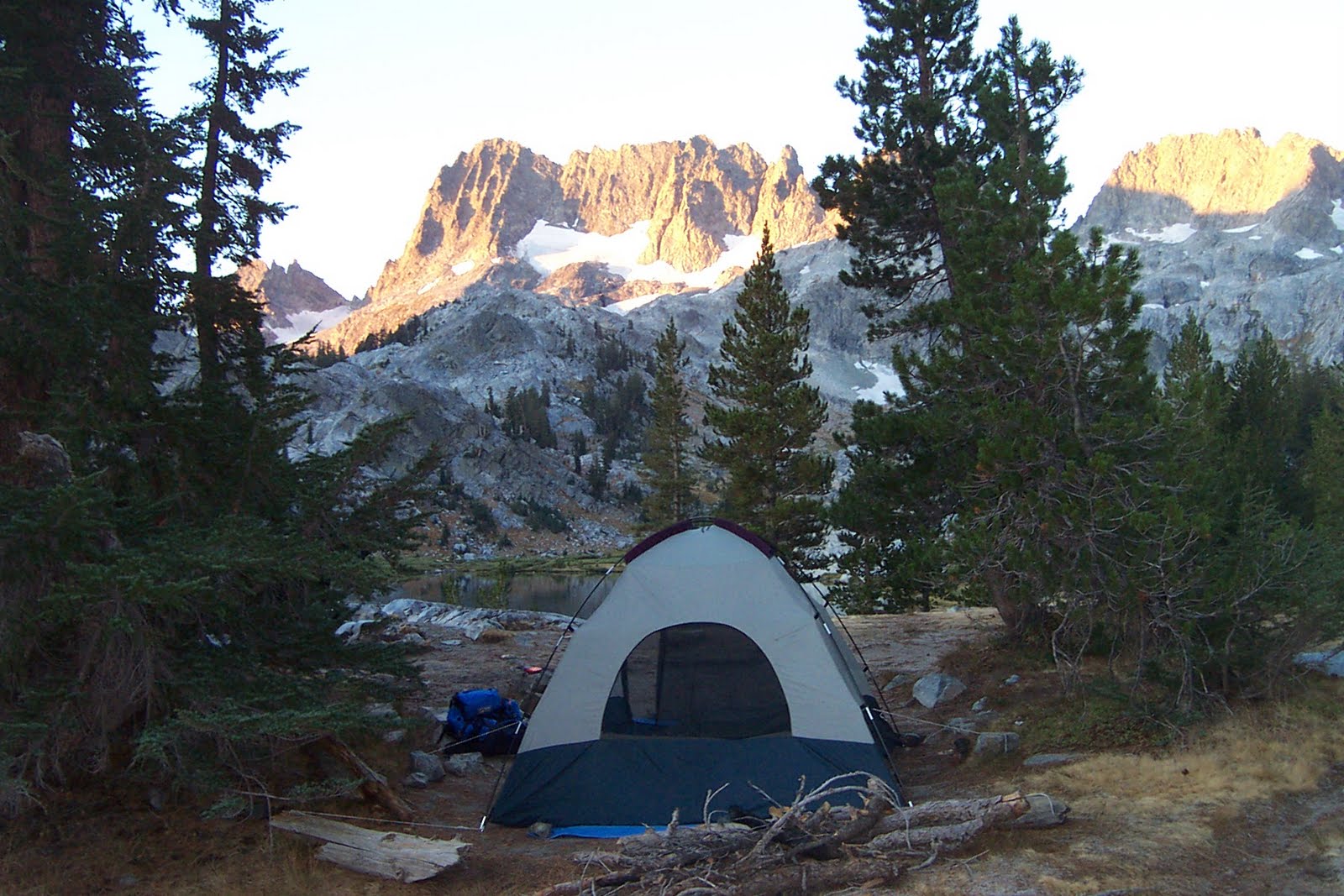
The trail skirts the north shore of this lake to the upper end of Shadow Lake (8750 – 4). We continued up Shadow Creek Trail passing several meadows with fine views of the Minarets and climbed up some short switch backs until we reached Lake Ediza (9300 – 6.2). Lake Ediza is located in a spectacular location at the headwaters of Shadow Creek set in the crown of Ritter and Banner Peaks and the Minarets.
Lake Ediza is described in the Starr's Guide as one of the brightest gems in the Sierra with views of Ritter and Banner the highest peaks north of Mount Abbot and one of the most noble mountain groups in the entire Sierra range. And we couldn't believe how beautiful it was. I felt that it surpassed any descriptions.
One of the guide books said because of the great scenery a stay overnight in this lake basin would be a memorable one. So this is where we camped. We got there with time to spare. So we set up camp and then took a side trip up to the base of Banner and Ritter peaks and still had time to get back to camp before sunset.

The next morning we left Lake Ediza and travel south along the east side of Iceberg Lakes outlet stream on an un-maintained trail to Iceberg Lakes (10,100 – 7.7) a wild setting at the very foot of the Minarets. This was pretty fantastic. It's a small lake in the shadows of the surrounding mountains. We then traveled south on the east side of this lake.
Our path then traveled steeply up and gained 400 feet of elevation to meet the creek draining Cecile Lake and then a last scramble up a steep pitch to reach Cecile Lake (10,300 – 8.2). This part was across boulder fields and there really is no trail.

This last distance measurement is a guess because no guide book has the distance listed because its not really a listed trail, but I can see on the maps it is a short distance from Iceberg Lake and is probably less than I guessed. Cecile Lake is described as the highest body of water on the east slopes of the Ritter range, wedged between the dark wall of the Minarets and the black ramparts of Volcanic Ridge, this could easily be a scene from another planet. The other guide book describes this as boulder littered shores with no campsites. This area again was just rock hopping across boulder fields with no real trail.
At this point from now on we were heading back down the Minaret Creek drainage and from here on all distances will in my description be a count down to the final destination. We boulder hopped around the east shore of Cecile Lake to the southern end and climbed a low, glacially smooth hill. At this point it was tough to find the rout down. Some were too step. From here we descend a talus covered slope with lots of loose rock with a creek draining into Minaret Lake. We followed the creek down to Minaret Lake (10,000 – 7.0). This lake with the impressive spire of Clyde Minaret to the west is an excellent choice for an overnight stay. I would highly suggest this option. So you can spent some time at this fantastic lake. But we just kept going.

From Minaret Lake the trail skirts the north shore of this lake and soon drops through sparce forest along meadow lined Minaret creek. 1.5 miles below the lake we reached a northbound trail junction that leads to and abandoned mine. The trail from here follows an abandoned access road for the mine and soon passes a series of cascades along Minaret Creek. This is a pretty cool spot but my camera batteries died so I have no photo
After this we reached a trail junction with the John Muir Trail just north of Johnston Meadow and Johnston Lake (8150 – 3). We bore right at that junction and soon crossed over to Minaret Creek’s south bank and soon came to another trail junction of the westbound trail to Beck and Holcomb lakes where we stayed left. Within another mile we reached another trail junction where we took the middle fork. After another .25 miles at another junction we bore left and came to a foot bridge that crosses the Middle Fork of the San Joaquin River (7500 – 1). Once we crossed the bridge we reached a southbound trail that leads to Devils Post Pile. We instead turn left and head north to the Devils Post Pile Camp Ground (7600 – 0.0) and our final destination where we could catch a shuttle back. But instead my wife and child met us here and we played along the river and had a picnic.
The total distance of this tip was only around 16 miles. The forest service people said it should be no problem to do the link between Lake Ediza to Minaret Lake even though it was on un-maintained trail. And they were right. There was just some minor route finding and scrambling but it is above tree line with no real way to get lost. It is described in the Hiker’s Guide to California as part of a 23 mile loop. With the high altitude at night it can get very cold. In fact I have encountered snow in the Sierras at the end of August before. This longer trip in The Hiker's Guide sounds good to me (it’s over 100 here in AZ as I write this).
The photos I have seen of Minaret Lake on the Web site for Devils Post Pile National Monument are beautiful. But it even better in person. Other photos I have seen of Banner and Ritter Peaks and the Minarets are impressive. But photos can't give you the scale. I believe this was one of the most impressive scenic trips I have or will ever take. Even though it was a short trip it was a great one.
To get a reservation for the permit for this trip you tell the Forest Service you are going to start from Agnew Meadows (Shadow Creek Trail) and come back Minaret Trail to Devils Post Pile. You can do two to three days. But it's short enough if your time is limited to do just a one night stay.
We were able to pick up our permit at the Mammoth Lakes ranger station one to two days before our trip, because we made reservations well in advance. We were required to have bear canisters for our food. We rented these. They are hard plastic canisters that are bear resistant. We did not see ant bears, but did see deer.

Wednesday, June 24, 2015

Fossil Creek, Arizona

When things start to heat up in Central Arizona there is a special place I like to visit to cool off. It is an amazing place just east of Camp Verde called Fossil Creek. Fossil Creek is a spring fed stream that runs southwest from its source for about fifteen miles and empties into the Verde River.
Fossil Creek is fed by a spring that produces close to a million gallons of crystal clear water an hour. This water comes out of the ground at a perfect 72 degrees and is full of minerals that give the creek an amazing aqua blue color. The surrounding area is a high desert environment in an entrenched canyon with mesquite, pinion pine and Juniper, along with some cactus and yucca. The canyon bottom is about 4300 feet in elevation while the canyon rim is above 6000 feet. While the canyon environment is typical of the high desert the environment along the creek is unique and special due to all the water. Along the creek is one of the most diverse riparian areas in Arizona, with over thirty species of trees and shrubs and over a hundred species of birds that have been observed in this unique habitat.
Visiting Fossil Creek is easy because a road runs parallel to it for a few miles and crosses it on a bridge in one location. The great swimming holes and easy access can make some of the spots very crowded. The places right below the bridge while nice are often very crowded.
Farther up the road from the bridge is a trail access that leads to a beautiful waterfall. The trail is only about a mile or so long and winds along the creek and on the way you pass several small falls and pools that are quite spectacular.
The falls at the end of this trail while often crowded are amazing and well worth the short mile hike. The falls are about 20 feet high with a deep pool of crystal clear water.
Many people come here to dive off the rocks and the falls into the deep water below. And it can be very crowded and busy on the week ends.
 If you want more solitude there are several other spots you can stop between the bridge and the falls trails that all have great swimming opportunities that offer more peace and quiet. 
If you want even more solitude there is a three mile long trail that leads to the spring at the source of the creek. This trail starts farther up the road toward strawberry and drops 1300 feet down to the spring. This will tend to have a little less traffic than the easy to reach spots that are close to the car. Hiking up stream past the falls or downstream from the springs will offer you more solitude as well, where you might find that perfect place to have all to yourself.
The Creek was not always this nice. For a long time much of the water flow was diverted by a dam and traveled by flume to a power plant. The work on the dam and power plant started in 1916 and in the 1920 and 30s this helped supply power to Phoenix. The power plant was decommissioned in 1999 and now the full flow of the creek has been restored, and the results are amazing. 
To get to this desert oasis called Fossil Creek you take Interstate 17 north from Phoenix or south from Flagstaff. You exit on State Route 260 heading east and pass through Camp Verde. You then turn right on Forest Road 708 (sign says Fossil Creek) less than 10 miles from I-17. The forest road is very winding and also very bumpy but it's passable by standard vehicles if you take it slow. It is about 15 miles of dirt road to the Fossil Creek Bridge. You used to be able to come down this same road from Strawberry but there was a landslide and the forest service will not fix it. But that road can get you to a trailhead to hike down into the canyon to get to Fossil Springs (the source of all this water). At Strawberry from Highway 87 you take Fossil Creek Road (Forest Road 708) for about 5 miles to get the Fossil Springs trail head. The first 2 miles or so is paved; the next 3 miles will be on a rough but maintained dirt road that any car can drive on. After about 5 miles on Fossil Creek Road you'll see a turnoff that leads to a parking lot on the right side.  Haven't had enough? Or need more informations? Here is another post for this fantastic Paradise in the desert!
 http://azjonesoutdoor.blogspot.com/2011/06/fossil-creek-part-two.html

Always check with the Forest Service before trying this.  They frequently close this area and sometimes restrict access to a certain number of people per day.